
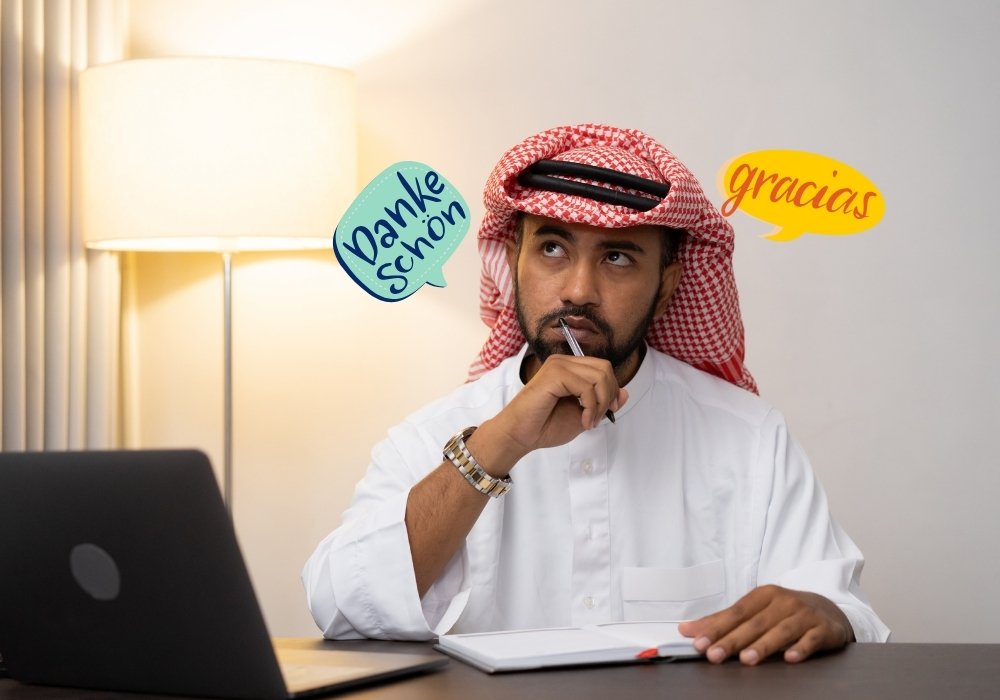
Learning a new language often raises concerns about difficulty, especially when the language structure is very different from your mother tongue. For many learners in the Middle East, the big question is whether german for arabic speakers is truly hard or simply unfamiliar. German and Arabic differ greatly in grammar, sentence structure, and writing systems, which can make German seem intimidating at first.
However, thousands of learners prove every year that german for arabic speakers is absolutely achievable with the right learning strategy. In this complete guide, we explore the real challenges Arabic speakers face when learning German, explain why those challenges exist, and show you how to overcome them effectively.
When people ask if german for arabic speakers is difficult, the honest answer is: yes, but it is not impossible. German is considered a medium-difficulty language, especially when compared to languages with unfamiliar scripts or tones.
According to language difficulty references from institutions such as the Goethe-Institut, German requires consistent study but rewards learners with a clear and logical structure once the basics are understood. Unlike English, German grammar follows predictable rules, which helps learners progress steadily after the initial stages.
Understanding how Arabic and German differ will help you learn German more efficiently and avoid frustration.
Arabic uses a right-to-left script with connected letters, while German uses the Latin alphabet written from left to right. For german for arabic speakers, this may feel strange at first, but there is good news:
German spelling is mostly phonetic
Words are pronounced as they are written
Reading becomes easier with practice
Many Arabic speakers actually find German reading easier than English after a short time.
German grammar is often the biggest challenge for german for arabic speakers.
German grammar includes:
Noun genders (masculine, feminine, neutral)
أدوات التعريف والنكرة
Four grammatical cases
Strict sentence order
Arabic grammar is also complex, but it relies on root systems and patterns rather than articles and cases. This difference explains why German grammar feels difficult at the beginning.

German nouns use:
der (masculine)
die (feminine)
das (neutral)
Arabic speakers already understand grammatical gender, which is an advantage. The challenge lies in memorizing German noun genders, as they are not always logical.
Tip: Always learn new nouns with their articles.
German cases change articles depending on the noun’s role in a sentence. This concept does not exist in Arabic, making it one of the hardest topics for german for arabic speakers.
The four cases are:
Nominative
Accusative
Dative
Genitive
Best approach:
Learn cases through real sentences and conversation instead of memorizing rules in isolation.
Pronunciation is often easier than expected for german for arabic speakers.
Arabic includes strong consonant sounds
German pronunciation is clear and consistent
Sounds like “ch” are familiar to Arabic learners
Umlauts (ä, ö, ü)
Long and short vowels
Word stress
With listening practice and guided speaking, pronunciation improves quickly.
German vocabulary may seem unfamiliar at first, especially because it does not share many words with Arabic. However, german for arabic speakers becomes easier when learners understand how German builds words.
German uses:
الكلمات المركبة
Logical word combinations
Example:
Krankenhaus (hospital)
krank = sick
haus = house
Once this logic is understood, vocabulary becomes easier to remember. Language comparison tools such as Europass show how German proficiency supports study and career mobility across Europe.
Many learners experience similar struggles. The key is knowing how to deal with them.
German learners often worry about grammar accuracy.
Solution: Focus on communication first, accuracy later.
Trying to learn all grammar rules at once causes confusion.
Solution: Learn grammar gradually through speaking and examples.
Self-study without guidance slows progress.
Solution: Follow a structured program designed for adult learners.
Despite the challenges, german for arabic speakers comes with strong advantages:
Experience learning Modern Standard Arabic
Familiarity with complex grammar systems
Strong listening skills
Clear motivation for work or study abroad
With proper guidance, Arabic speakers often progress faster than expected.
The most effective way to learn German includes:
Speaking-focused lessons
Clear grammar explanations
Qualified instructors
Real-life communication practice
This is why many learners choose structured courses like the German program at Lingua Learn, designed specifically for adult learners:
👉 https://lingua-learn.jo/adults/german-course/
For learners who want bilingual support and native-language context, Lingua Learn also offers Arabic programs:
👉 https://lingua-learn.jo/adults/arabic/
Yes, mainly because of grammar and cases, but pronunciation is often easier than English.
Most learners reach B1 level within 6–12 months with consistent study.
German grammar is different, not necessarily harder. Arabic grammar is also complex but structured differently.
Yes, online learning works very well with live instructors and structured lessons.
Absolutely. German opens doors to education, work, and migration opportunities in Europe.
So, is German hard? For beginners, german for arabic speakers can feel challenging at first due to grammar and sentence structure. However, once the basics are mastered, German becomes logical, predictable, and rewarding.
With the right learning method, strong guidance, and regular practice, german for arabic speakers can turn difficulty into confidence and real-life success.
🎯 Ready to start your German journey?
Join a structured German course designed specifically for adult learners and Arabic speakers at Lingua Learn:
👉 https://lingua-learn.jo/adults/german-course/
Learn with expert instructors, practical lessons, and real communication—and discover how achievable German really is.